




It is such a thrilling experience to bring home a puppy. And at the same time, it is quite a messy experience. In addition, it is a little noisy. Moreover, in some instances, it can be quite puzzling when it seems that nothing works. This tutorial on how to train a puppy reveals the actual process, not perfect, not robotic, just simple steps that actually work.
Training is not a straight line. It sometimes works. At other times, the opposite. That’s the reality. The main thing is consistency, timing, and knowing what the puppy is really learning from you.
When to Start Training a Puppy
Many beginners tend to delay the training session. Training does not necessarily start at six months. Instead, it starts when the puppy gets to your home. Even when they are just 8 weeks old, puppies are already figuring out where to pee, when to bark, and what attention brings them the most.
Early training involves:
- Puppy-finalize their names
- Introduce potty schedules
- Teach everything to be gentle
- Getting comfortable in the crate
- Learning basic commands/boundaries
Keeping the training short is the best approach. Two or five minutes are enough. Stop there. Puppies quickly get tired of learning, and longer sessions merely make them frustrated.

Puppy sits obediently looking at the owner, who has treats in hand.
Basic Foundations Before You Start
Training puppies falls short when the very basic things are left aside. Puppies are always first given the ground plan before commands.
Routine overrides commands, probably
All meals are given together time exists before going home. All toilets are done together time is made before bed. Through this silent routine, discipline is taught without uttering a word.
Reward timing is essential
Rewarding the puppy late may result in negative associations, and the puppy might link the reward to incorrect action. Reward time should be immediate, not even a second after.
Tone is way more important than the content of words
At best, puppies understand individual words, but not sentences. They rely on tone. Therefore, a quiet, loving tone is best.
Puppy Crate Training
Crate training is a great method to help with housebreaking, safety, and sleep routines. It can also be a great way to keep a puppy from scratching, chewing, and exhibiting all other destructive behaviors when you are gone.
However, the puppy should not be shocked or made to feel as if the crate is in any way their punishment. It should be more of a sleeping room, a calm, safe, and easily understood zone.
Ways to begin:
- Keep the door to the crate open
- Place treats in the crate
- Allow the puppy to enter the crate voluntarily
- Never force or coerce
While some puppies hardly take one step before going into their new crate, others take their time and hesitate. You do well not to start rushing this stage.
Crate Training Tips for Puppies
Small changes make a huge impact.
- Place the crate in your room for the first few nights
- Use bedding that is soft, but not thick
- For comfort, add a chew toy
- In the beginning, keep the duration of the sessions very short
- Never punish by sending the puppy into the crate
- For calmness, partially cover the crate
Additionally, if your puppy immediately cries the moment you open the crate, do not respond right away. Wait for a couple of seconds of silence.
Puppy Crate Training Schedule
A structured environment is what helps puppies to feel settled. Here is a basic schedule that continues to work really well:
| Time | Activity |
|---|---|
| 7:00 AM | Wake up + potty |
| 7:15 AM | Breakfast |
| 7:30 AM | Playtime |
| 8:00 AM | Crate nap |
| 10:00 AM | Potty break |
| 10:15 AM | Training (5 min) |
| 10:30 AM | Free play |
| 11:00 AM | Crate rest |
| 1:00 PM | Potty + lunch |
| Afternoon | Repeat cycle |
| Night | Calm routine + crate |
Puppies are going to sleep a lot. At times, 18–20 hours. The crate actually helps to regulate that.
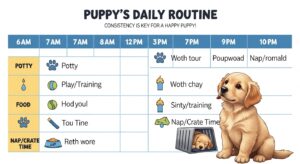
Daily routine chart for a puppy
Crate Training Puppy at Night
For most people, nighttime is the point where things become challenging. The whining. The scratching. The constant feeling of doing something wrong.
Here is the help:
- Take the puppy potty right before bed
- Keep the crate by your bed
- Do not have play sessions late at night
- Use a calming and soft tone
- Ignore short whining bursts
If the whining is for more than 10 or 15 minutes, the puppy might be signaling a potty need. Acting boring can solve the situation. No play, pass straight outside, and then back.
Within a few nights, a puppy is usually able to adjust to this.
How Long to Crate Train a Puppy
There is no magic number. A handful of puppies can be trained in a week. A handful may take a month. It is based on the following:
- Age
- Breed
- Previous environment
- Consistency
- Energy level
Typical guide:
| Age | Max crate time |
|---|---|
| 8–10 weeks | 1 hour |
| 10–12 weeks | 2 hours |
| 3 months | 3 hours |
| 4 months | 4 hours |
| 6 months | 5–6 hours |
If a puppy is left for too long in the crate, it leaves room for it to have accidents. And consequently, they undo the training work so far.
Best Crate Training Methods for Puppies
The truth is, there is not just one method. However, a handful of methods are superior.
The Gradual Entry Method
Set the crate for free exploration by the puppy. Reward calm entering. Slowly extend the keep time.
The Meal Inside Crate Method
Serve meals in the crate. Puppy gradually sees the crate as a place where nice things happen.
The Short Exit Method
Put the puppy in the crate for 2 minutes. Leave room. Return calmly. Increase the time.
It is good to mix and match the methods. Remain adaptable.
Puppy inside a crate eating.
Puppy Crate Training Guide
Step-by-step, no-nonsense way:
- Put the crate somewhere with minimal disturbances
- Equip it with a blanket and a toy
- Throw in a treat
- Allow the puppy to freely enter the crate
- Close the crate door for a very short moment
- Open the door prior to any whining
- Do it several times
- Gradually lengthen the interval
The goal is not perfect but regular.
Crate Training for Beginners
If you are a first-time puppy owner, then keep it simple. Don’t bog yourself down with details.
Concentrate on:
- Creating the same schedule every day
- Conducting only short sessions
- Speaking with a calm tone
- Delivering quick rewards
- Showing lots of patience
Remember, it is not about the control but rather the clarity. Puppies will behave better when they actually understand what you expect of them.
Potty Training Basics
Potty training is often done concurrently with crate training. The main part is the frequency of taking the puppy outside.
The puppy should be taken outside:
- After waking up
- After eating
- After playing
- Before sleeping
- Every 1–2 hours
Praise right away. Not after returning indoors. Once again, timing.
Accidents shouldn’t be a big deal. Clean them up in silence. Don’t scold. Puppies don’t make the connection between punishment and past behavior.

Puppy outdoors in the grass on potty training
Teaching Basic Commands
Start with the easiest ones:
Sit
Keep treating just over the nose and not touching it. The puppy will try to naturally sit.
Come
Use a happy voice.
Stay
After the puppy has done the sit, use the hand signal and go back a few steps, little by little. Later on, you can reward the duration of the stay that is lengthened.
Ending ahead of time is advisable, by the way, when interest gets lost.
Bite Inhibition Training
It is just fine, even expected that puppies bite. But this behavior must be regulated.
When a puppy bites:
- Softly say “Ouch.”
- Stop interaction
- Offer a chew toy
- Resume play calmly
Slowly, the puppy is able to figure out ways of using his mouth in a less aggressive manner and keeping control.
Try not to play rough, as this will encourage biting even harder.
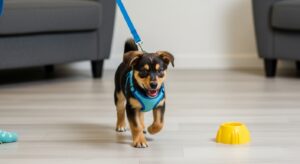
Leash Training Early
Waiting until your puppy is big enough is a mistake. Begin even inside the house.
- Put the leash on briefly
- Drop the leash and let the puppy carry it around
- Reward for walking nicely
- Spare force
Quick strolls. A couple of minutes only. This is sufficient.
Socialization Training
Some examples of socialization include:
- Different sounds
- Different people
- Different surfaces
- Gentle handling
- Car rides
The goal is not to stress, but rather to gradually get the puppy used to new things.
Proper socialization is a key factor in preventing fear from arising later on.
Training Timeline Overview
| Age | Focus |
|---|---|
| 8 weeks | name, potty |
| 9 weeks | crate comfort |
| 10 weeks | sit, come |
| 11 weeks | leash intro |
| 12 weeks | bite control |
| 3 months | stay, routine |
| 4 months | longer crate |
| 5 months | impulse control |
Puppies don’t follow calendars perfectly. This is just a guide.
Common Training Problems
The dog refuses to obey
Most probably, the dog was distracted. Try again in a quiet place without distraction.
The dog cries in the crate
It is the normal adjustment phase. Keep everything else the same.
The dog pees in the house
You need to increase the frequency of potty breaks.
The dog bites a lot
More rest is required, or a few chew toys will solve the problem.
In most cases, a few small changes are what it takes to get everything back on a smooth track again.
Realistic Expectations
There will be days that seem to be only one step forward. Then, suddenly, a bunch of steps backward. That’s part of dog training. Dogs sometimes forget and then remember again.
Consistency beats perfection.
Even five minutes daily adds up. If you’re also working on bonding activities during training, you can mix in reward-based routines like treats or special moments. Some owners even use food-based rewards from guides like how to bake a nutritious dog birthday cake at home to reinforce positive behavior during puppy crate training sessions or after successful crate training of a puppy at night.
FAQs
1. How Long Does It Take to Train a Puppy?
Basic teaching can be achieved in 4–8 weeks. Full behavior and maturity take several months.
2. Should I Crate My Puppy Every Night?
Definitely, especially during the first few weeks. Crate helps to power the sleep routine and keeps away accidents.
3. At What Age Should a Puppy Start Training?
Around 8 weeks or so. Even earlier puppies learn through routines without realizing.
4. Is It Okay If Puppy Cries in the crate?
Short bursts of crying are normal. Long continuous crying could be a need or unpleasantness.
5. How Many Times A Day Should I Train My Puppy?
This is a good number: 3–5 times of short training. Each is 2–5 minutes. Keep it light.